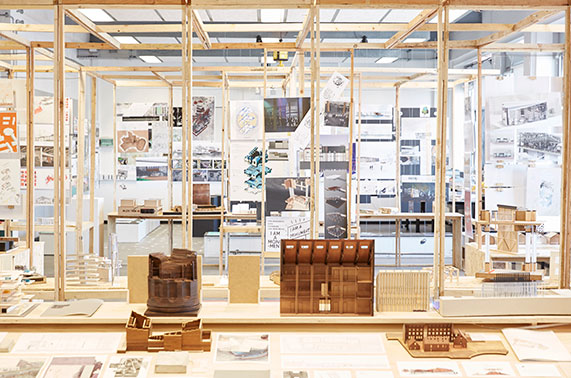
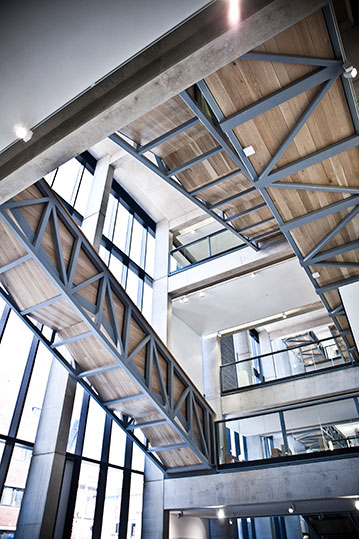

Thinking Infrastructure

Thinking Infrastructure responds to the weakening of deep thinking in the contemporary information age.

Screens, notifications, fragmented tasks and excessive information constantly occupy people’s attention, making thought increasingly scattered, passive and temporary.

n response, the project explores how architecture can support deeper thinking through the relationship between cognition, body and space, while also reimagining the relationship between people and intelligent devices.

The project transforms the Mancunian Way from a traffic-dominated infrastructure into a new urban learning environment.

It proposes a staged spatial system, shifting from open environments with low order and low information density towards spaces of greater density, clarity and organisation.

Order and information density form the first layer of translation between cognitive theory and architectural space.

Body states then complete this translation at a more detailed scale.

Roaming, leaning, sitting, discussing, writing and testing are treated as spatial expressions of different modes of thought. Based on these body states, movement, boundaries, furniture and facilities are further developed, turning each level from an abstract cognitive gradient into a specific architectural condition.

The seven levels are not a fixed route from L1 to L7, but a set of selectable thinking environments. Users can enter and switch between different levels according to their habits, moods, tasks and cognitive states.

Technology supports this system by remaining hidden in intuitive spaces and becoming more explicit in rational spaces.