
Stanier & Bond Theatre
The Stanier & Bond Theatre critically reinterprets the industrial heritage of Crewe Works to provide a productive heart of theatre, making, and public participation, providing a site of active memory through place specific architecture. The proposal responds to Crewe’s demand for a civic, cultural and productive heart within the town centre.
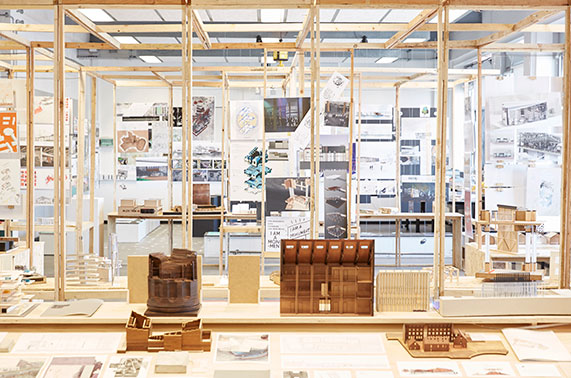
Two adaptable halls housing theatre and workshop spaces encourage public engagement, allowing the craft to be a performance equal to the theatre itself. Overhead cranes span the halls, supported by natural ventilation towers, reflecting the lost chimneys of the works. The project used modelmaking as a creative tool for the detailed resolution of the towers at 1:25, key to continuity’s approach.
The Tectonic strategy is built upon a rigorous study of Crewe Works and technical precedent studies of Theatres. Monolithic brick towers reflect the lost chimneys of Crewe Works. These perform as the primary structure, with the surrounding building collaged between the uniform grid dependant of the spatial demand. Tiered levels support overhead cranes that transform the space, in homage to the buttresses of the original erecting shop. The cranes reintroduce the assembly line process from Crewe Works for the making of theatre sets, originally implemented by Chief Engineer Roland Bond. The sets are repurposed or recycled, reflecting the repairing of Steam Locomotives at Crewe Works. The ‘Black Five’ locomotives by Sir William Stanier were workhorses widely used across Britain, often bearing parts from other engines.
The Towers serve the building environmentally, providing sufficient passive ventilation through the stack effect for an audience of 800 during a theatre performance, assisted by technical equipment heat gains. Heat recovery systems, placed within the chimneys ensure energy is conserved and can supplement the passive system. They are fabricated out of reclaimed brick, resourced from buildings demolished in our masterplan.
