

Re:Assembly
Large scale infrastructure has left permanent scars across our cities. Roads divide the urban environment both physically and socially, creating barriers between communities. Underpasses and crossings designed to bridge these voids are widely perceived as unsafe and are often avoided. As a result, many are abandoned, closed or replaced by new infrastructure. This project questions that replacement, proposing that improved underpasses could offer a more efficient solution. Across Manchester, 32 underused crossings were identified.
Re:Assembly proposes a workshop that develops and tests interventions to transform these neglected spaces. Acting as a central hub, the building produces and showcases light, sound and sculptural installations before they are deployed across the city. Once complete, the structure is disassembled and relocated for reuse elsewhere.
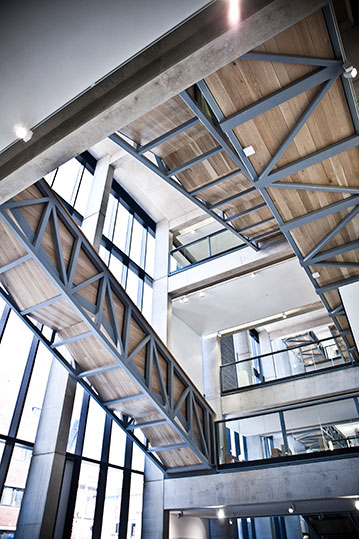
This approach extends into the architecture of the building.Constructed from standardised timber components, the modular system prioritises adaptability and deconstruction. A scalable 3m x 3m structural grid and interchangeable SIP pods allow the building to respond to specific site conditions and user needs.
Materiality is challenged through the acoustic strategy, adopting mycelium panels as a biodegradable alternative to synthetic products.
Grown from spores, the panels provide effective sound absorption whilst reducing embodied carbon and waste. Their porous structure absorbs sound waves through the material, while varied outer textures reflect and diffuse.
